

Olivia is 38, a mom of three and works full-time. When she came to me she had bloating, gas and stomach pain every day, plus heartburn and bowel movements that swung between constipation and loose stools. She had already cut out gluten and dairy. Five months later, after a GI-MAP stool test and a three-phase plan, her digestive symptom score had dropped from 25 to 5 and her whole-body score from 116 to 27. She didn’t have to give up any more foods to get there.
I walked through Olivia’s whole case in this video, including her test results and her final survey. The written version is below if you’d rather read it.
Client Case Study: Chronic Bloating, Constipation and Heartburn (23 minutes). Watch on YouTube
Meet Olivia
About Olivia
38, mom of three (ages 10, 12 and 14), works full-time. She runs, lifts, does yoga and has trained for a marathon.
- Main symptoms
- Daily bloating, gas and stomach pain, heartburn, constipation alternating with loose stools, feeling heavy and tired after meals
- Already tried
- Gluten-free and dairy-free eating, Whole30, probiotics, a digestive enzyme, a laxative, and coffee to get things moving
- Testing
- GI-MAP stool test, bloodwork, an at-home transit test and the Bristol stool chart
- Timeline
- Three phases over five months, June to November
Between work, three kids and her training, most of Olivia’s week is spoken for. She’s had stomach trouble since she was a kid, and over the last year and a half it got a lot worse. In her words: “I haven’t felt well since, honestly, probably 2023.”
On paper she was doing everything right. She’d cut out gluten, dairy and processed breads after hearing they were inflammatory. Real food in the morning made her bloat, so she had a protein shake for breakfast instead, and when she went out to eat she ordered the salad to be safe. She still felt awful.
What every day looked like
Every single day she had bloating, gas and stomach pain. She had some heartburn too, and her bathroom habits were all over the place: she’d strain at first, then things would turn loose, sometimes on the same trip. That back-and-forth is so common, and really confusing. A lot of women don’t know whether to call it constipation or diarrhea, because it’s a mix of both.
After meals she felt heavy and tired, and she needed her coffee to go to the bathroom each day.
When I asked for her top three goals, she wrote:
- Stop the bloating and inflammation
- Lose the weight and inches she had gained
- Feel less stressed about food
I hear that last one from almost every client.
What other people didn’t see
Olivia often ate separately from her family, and her kids had started asking why she could only eat certain things and why she wasn’t eating what they were. She picked restaurants based on what felt safe. On bad gut days it was hard to focus at work, and even planning meals felt like a lot. Moms carry a lot of this. You end up thinking about food all day, for yourself and for the whole family.
Where her symptoms started
Every client starts by filling out a Medical Symptom Questionnaire (MSQ). It’s a symptom survey that shows me how the whole body is doing. Olivia’s total score was 116, which told me her body was really struggling.
Digestion was the loudest part. Each symptom is scored from 0 to 4, and 4 means frequent and severe. In the digestive section she scored 25 out of a possible 28, with diarrhea, constipation, bloating, gas, heartburn and stomach pain all at 4. She was dealing with these every day.
What she had already tried
Olivia described the year before we met as a “yo-yo journey.”
- She went gluten-free and felt great for a few months. Then the bloating came back and didn’t go away, whatever she tried.
- Her thyroid labs all came back normal.
- An X-ray showed constipation, and she was told to take a laxative.
- She’d been taking probiotics and a digestive enzyme ever since, and wasn’t sure they were helping.
- Mushroom coffee got her to the bathroom, but with urgency. She felt like she had to run.
- Whole30, which she tried while training for a marathon, added so much stress around food that everything got worse.
Each of these either helped for a little while or patched up one symptom, and nobody was asking why her gut was reacting in the first place. Olivia told me, “I think something must be agitating my gut.” She was right, and cutting more foods was never going to tell her what it was. That’s why I always say: before you cut anything else out, find out what’s actually going on.
Phase 1
Calm the gut and get answers
Phase one was about calming her gut down and getting answers. First we ordered a GI-MAP, a stool test that gives a detailed look at what’s going on inside the gut. Its results would shape everything in the next phase.
While the test was on its way, we worked on her foundations, because your gut needs to feel safe and nourished before anything else can work. We focused on four areas.
- Nourishing her body. Three balanced plates a day, about four hours apart, and fish twice a week. She swapped her flavour drops for minerals in her water and cut back on sparkling water and pop, since the bubbles add to gas and bloating.
- Calming her nervous system. Digestion works best in “rest and digest” mode, so she sat down to eat, slowed down and chewed well. Humming or singing Happy Birthday before meals helps too. It always gets a laugh, but it tells your body it’s time to digest, and kids love joining in. She also picked 15 minutes a day of anything she found relaxing, and we worked out a bedtime routine she could stick with.
- Getting things moving. More water, a daily bathroom routine after breakfast so her body didn’t depend on coffee, and gentle belly massage.
- Adding gentle supports, one at a time. Digestive bitters to help her break down food. A gentle fiber to feed her good bacteria, which helps with constipation and loose stools alike. Gut lining support to soothe the lining of her gut and calm her reflux while everything else settled down.
We added one support at a time, waited to see how she felt, then added the next, so we always knew what was helping. She tracked her symptoms in a journal, and with that and her weekly check-in forms I could see how her body was responding and adjust straight away instead of waiting for our next session.
Her last check-in before phase two showed she was going to the bathroom every day. Remember, this is the woman who used to strain and then have loose stools on the same trip. She said she felt very positive about her gut health, and her win that week was that her bowel movements felt better and more complete. That was the week her kids went back to school, too.
She posted this in our moms’ community:
I wish I learned sooner that it doesn’t have to be complicated. You just have to find what works for you. I think in the beginning things feel so overwhelming, but it really doesn’t have to be that way.
Olivia
So many women put off starting because they picture too many rules and supplements to keep track of on top of everything else. They wait for life to calm down, and it never really does. We go one step at a time, in the order your body needs, and build it around your schedule and your family.
What her GI-MAP showed
Here are the parts of her report that stood out.
Missing helpful bacteria
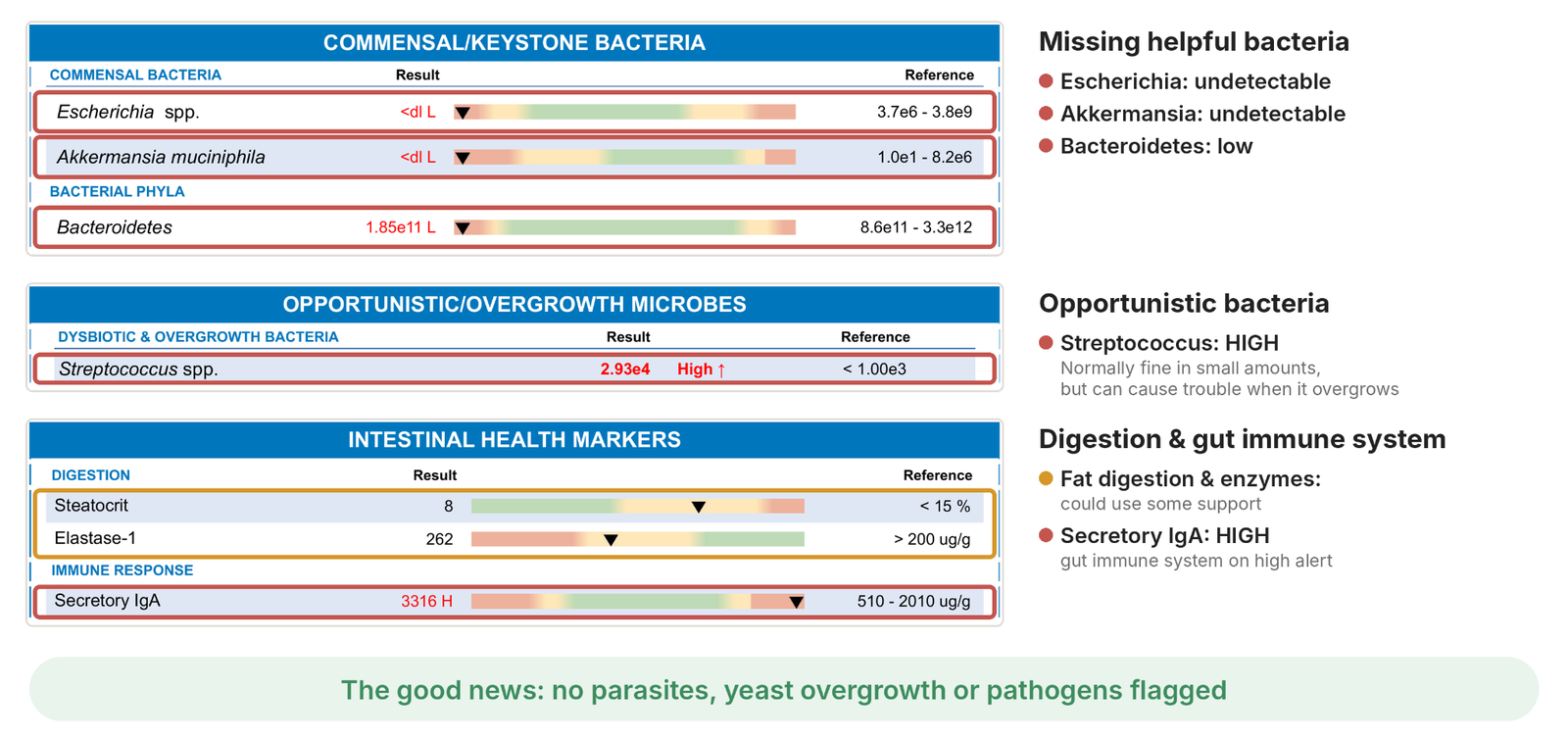
Escherichia and Akkermansia were below the level the test can detect, and Bacteroidetes, one of the main groups of good bacteria, was low. Akkermansia is one I always like to look for, because it helps look after the protective lining of the gut, so she needed some support there.
An overgrown opportunistic bacteria
Streptococcus is fine in small amounts but can cause trouble when it overgrows. Hers was almost 30 times the lab’s upper limit.
Digestion and the gut’s immune system
Her fat digestion and enzyme markers weren’t flagged in red, but they were in the yellow-orange zone, so we helped her break down fats and proteins. Her secretory IgA, the gut’s first line of defense, was high at 3,316 (the lab’s range is 510 to 2,010). That told us her gut was on high alert and reacting to something.
What it didn’t find
No parasites, no yeast overgrowth and no pathogens. So the plan was to rebalance her bacteria, calm her gut, support her digestion and rebuild the good bacteria she was missing.
Phase 2 · about 12 weeks
Go after the root cause
Knowing what was going on meant we could be more targeted.
- Antimicrobial support. A targeted plan to clear the Streptococcus overgrowth. We started at a low dose and raised it slowly over a few weeks so her body could keep up and she didn’t get a die-off (Herxheimer) reaction.
- Protecting her gut. While we cleared, we added a beneficial yeast to help firm up her stools and kept the gut lining support going to calm her high secretory IgA.
- Nourishing her. Bloodwork showed low iron, so she ate iron-rich foods with vitamin C, kept coffee and tea away from those meals because they can block iron absorption, and added copper-rich foods, since copper helps the body use iron.
- Keeping the foundations going. The bitters, fiber, balanced plates and calming habits from phase one carried on. They’re what will keep her from ending up back where she started.
- Checking in and adjusting. If anything flared, she paused the newest step and messaged me, and we adjusted. That’s how we keep people feeling better during this phase.
Phase 3
Rebuild and step down
Once the overgrowth was cleared, we moved on to rebuilding.
- Repopulating. We brought in targeted beneficial bacteria, one at a time, to replace the helpful bacteria missing from her test and build a more diverse, resilient gut. It’s like replanting a garden after you’ve pulled the weeds.
- More iron support. A gentle nutrient to help her body use iron well.
- Bitter greens. Arugula, radicchio and dandelion greens, so she could rely less on her digestive bitters.
- Fiber and calming habits. These kept going, along with the way of eating we set up at the start.
- Weaning and maintenance. I don’t want anyone on supplements forever. Olivia has a clear plan for stepping down from hers, and she knows what to do if symptoms creep back after travel, a stressful stretch or a round of antibiotics, so she can look after her gut on her own.
Her results after five months
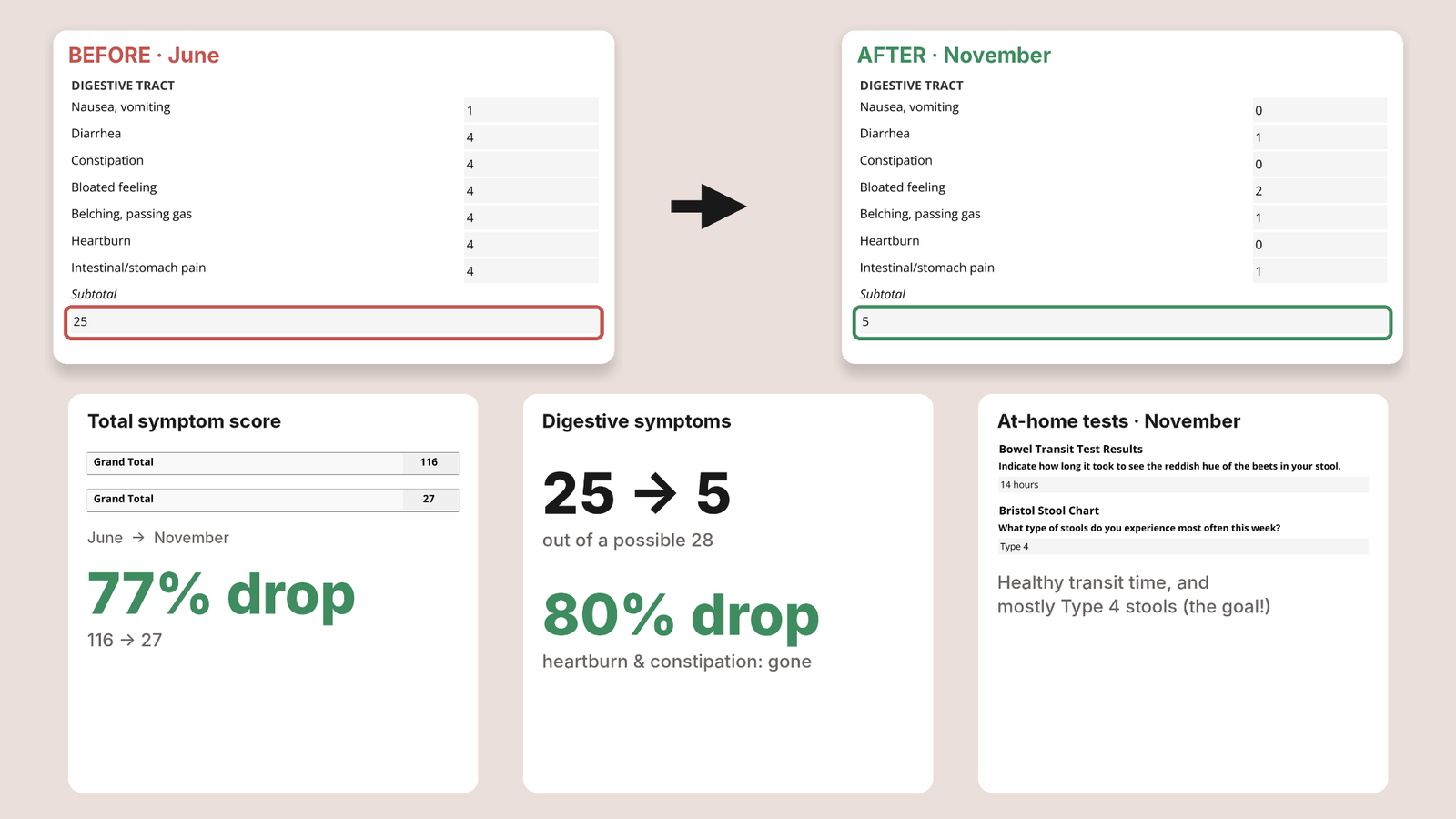
In June Olivia scored 4 on almost every digestive symptom. By November most of those had dropped, several to 0, and her digestive score had gone from 25 to 5. Her whole-body score fell too, from 116 to 27.
Every client does a couple of at-home tests at the start so we can compare later. Olivia’s transit test came back at 14 hours, a healthy range, and her stools were mostly Type 4 on the Bristol Stool Chart, which is what we want to see. She started out with both constipation and loose stools, so Type 4 is amazing.
Her bloating is still at a 2, and that’s normal. I tell all my clients bloating is usually the last symptom to go: your gut has to calm down, heal and get used to the fiber, probiotics and foods you’re bringing back, and that takes time. She knows her triggers now and what helps, and she has a plan if it flares up.
In her own words
These answers come from Olivia’s final survey.
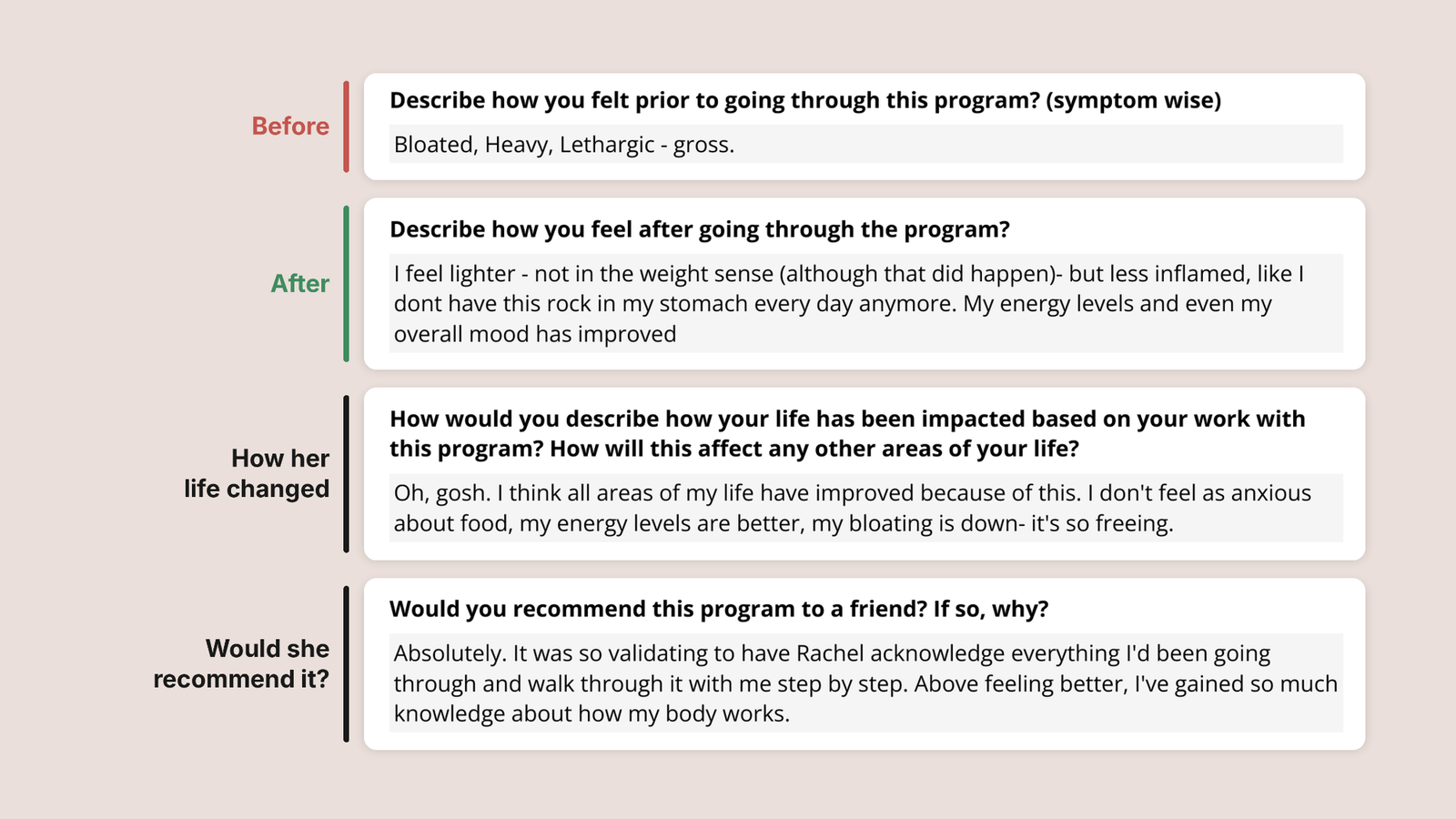
Before the program, she described feeling “bloated, heavy, lethargic, gross.” Afterwards she said she feels lighter and less inflamed, without “this rock in my stomach every day,” and that her energy and mood have improved. She doesn’t feel anxious about food anymore, and she called it “so freeing.” To me, that’s what food freedom looks like: getting through the day without thinking about your stomach.
It was so validating to have Rachel acknowledge everything I’d been going through and walk through it with me step by step. Above feeling better, I’ve gained so much knowledge about how my body works.
Olivia, final survey
Why it worked this time
- We worked on how her gut functions. Cutting out a food removes a trigger, but her gut was still reacting. We worked on how she digests, how things move through her system, her gut bacteria and her gut lining, and once those work properly the body can handle more foods again.
- We started with the basics. Before any supplements, we looked at how she was eating, drinking, sleeping and slowing down.
- We tested. Her stool test showed what was going on, so her plan was built for her body.
- We went one step at a time. Adding one thing at a time kept it from feeling overwhelming, and we always knew what was helping.
- We looked at her whole health. Low iron was part of why she felt so drained, so we supported that too.
Your bloating has a reason, and you don’t have to just live with it. For another client story, read my case study on lifelong constipation, or start with the root causes of bloating.
Doing everything right and still bloated?
I use this same three-phase process with every client in The Bloat Fix Method, my four-month one-on-one program.
Book Your Free Gut Strategy CallEveryone’s body is different, so your results may not match Olivia’s. This case study is for education and isn’t medical advice.