
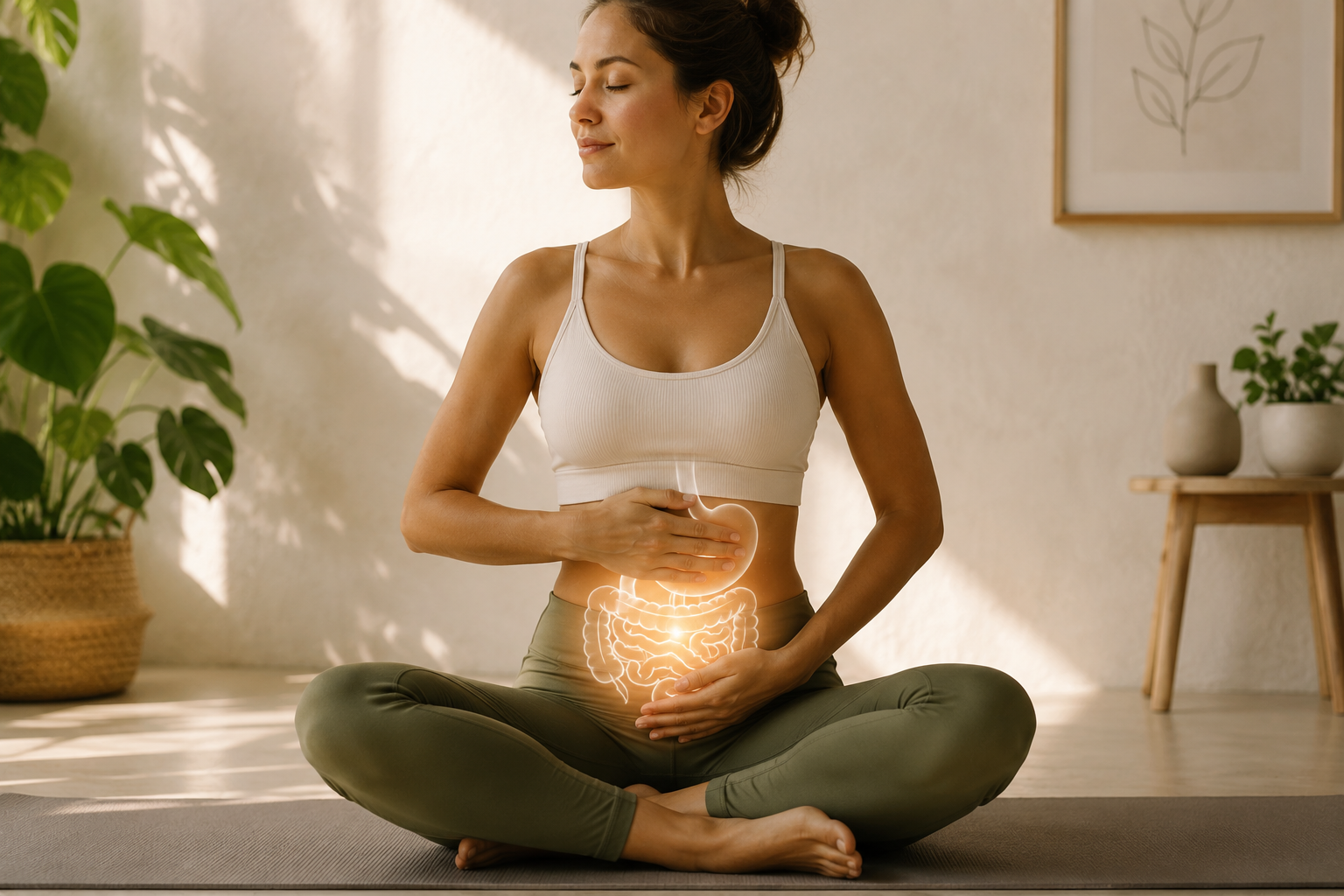
Ongoing bloating usually comes from gas, stool and fluid building up in your gut while your diaphragm and abdominal muscles push the belly outward instead of making room. The most common triggers are constipation, food reactions, IBS, swallowed air and hormone shifts. It often builds through the day, and it often has a functional cause, meaning the gut isn’t damaged but isn’t working smoothly. A few patterns do need a doctor, and I’ll point them out below.
If your stomach is flat in the morning and tight, swollen and several centimetres bigger by dinner, that’s a very common pattern, and there’s usually a reason for it.
Why does my belly swell up when I’m bloated?
Two things happen at once. First, gas, stool and fluid add volume to your gut. Second, the muscles that are meant to make room for that extra volume sometimes do the opposite.
In one lab study, researchers added gas to the colon. In healthy volunteers the diaphragm relaxed and the front abdominal muscles tightened, which absorbed the extra volume. In people with bloating, the diaphragm contracted instead and one of the abdominal muscles relaxed, so the belly pushed outward (Villoria et al., 2011). Scans of 45 patients with visible distension, 42 of them women, showed the same pattern: the diaphragm contracted and moved down, and the front of the abdomen pushed out, adding about 3 cm to their girth (Barba et al., 2015).
That’s why bloating can look dramatic without a huge amount of gas. In the same study, a couple of sessions of biofeedback training, which teaches you to release those muscles, reduced girth by about 2.5 cm. Doctors also separate bloating, a subjective sensation, from distension, a measurable increase in belly size, and the two often but not always go together (Mari et al., 2019).
Is it bloating or belly fat?
These general patterns can help you sort it out. They are not a diagnosis, and it is possible to have both.
| Bloating | Belly fat | |
|---|---|---|
| How it changes | Often flat in the morning and bigger by evening | Fairly steady from morning to night |
| How it feels | Tight, full or gassy, sometimes hard or uncomfortable | Soft, with no tightness or pressure |
| Link to eating | Often worse after meals or certain foods | Not tied to meals |
| Does it go away? | Usually eases with passing gas or stool, or overnight | Changes only with a longer-term change in weight |
| Other clues | Gas, burping, changes in bowel habits | Gradual change over weeks or months, with clothes fitting differently across your body |
What your bloating pattern may be telling you
Timing is one of the most useful clues. Use this table as a starting point, then read the causes below.
| When it happens | Common causes | Worth trying or asking about |
|---|---|---|
| Soon after eating | Eating fast or swallowing air, fizzy drinks, fermentable carbohydrates (FODMAPs), lactose | Slow down at meals, keep a food and symptom diary, and look at lactose and high-FODMAP foods |
| Flat in the morning, bigger by evening | Constipation, functional bloating and distension, IBS | Look at fibre, fluids and how regular your bowel movements are (foods that help constipation), and ask your doctor about IBS |
| Around your period | Normal hormonal shifts, and sometimes endometriosis | Track it across two or three cycles, and see your doctor if periods are painful or bloating is severe |
| After specific foods | Lactose, FODMAPs, or celiac disease | Ask about celiac testing before you cut out gluten, because the tests need you to be eating it |
| Alternating constipation and diarrhea | IBS | See your doctor for an assessment |
| Constant, painful, or not easing at all | Needs a medical assessment | See your doctor. Read the warning signs below. |
The most common causes of bloating
Constipation and slow digestion
When stool backs up, gas gets trapped behind it. Bloating and distension overlap with functional constipation, irritable bowel syndrome (IBS) and functional dyspepsia (Mari et al., 2019). If your bowel movements are infrequent, hard or incomplete, start with my guide to foods that help constipation.
Food reactions
People who don’t digest lactose well can develop pain, bloating and diarrhea after having it. How much it bothers you depends on how much lactose you eat, how much lactase your body makes and your gut microbiome (Misselwitz et al., 2019). Fermentable carbohydrates (FODMAPs) are another common trigger. In a 2025 review of 28 randomized trials in IBS, a low FODMAP diet was the only diet that eased bloating or distension better than a usual diet, although most comparisons in the review were rated as low or very low confidence (Cuffe et al., 2025). It works best with guidance and a reintroduction phase, not as a forever diet.
If you suspect gluten, ask about celiac disease first. It is diagnosed with blood tests and a biopsy that both need you to still be eating gluten (ACG guideline, 2013). I explain how I think about gluten and dairy in Gluten, Dairy & Your Gut.
IBS and functional bloating
Functional bloating and distension is common and often overlaps with IBS. Researchers point to gut hypersensitivity, the muscle reflexes described above, poorly absorbed fermentable carbohydrates and changes in the gut microbiome as possible causes, though the picture isn’t fully understood (Mari et al., 2019).
Bacterial overgrowth (SIBO)
A 2020 meta-analysis found that SIBO was about 3.7 times more likely in people with IBS than in people without it, although the quality of the evidence was low (Shah et al., 2020). Testing has its own limits, which I cover in the root causes of bloating guide, along with other causes such as low stomach acid and gut infections.
Swallowed air and eating habits
Eating quickly, chewing gum, drinking through straws and fizzy drinks can all add air to your gut. These are also some of the easiest habits to change.
Why bloating gets worse around your period
In a survey of 156 healthy women, 73% had at least one digestive symptom (abdominal pain, diarrhea, constipation, nausea or vomiting) in the days before or during their period, and women who also felt low or anxious were more likely to report several (Bernstein et al., 2014). That makes it worth tracking your bloating across a couple of cycles before blaming a food.
Sometimes severe bloating that flares with your cycle is a sign of endometriosis, which is sometimes nicknamed “endo belly.” Endometriosis affects up to 10% of women of reproductive age, about 90% of those affected report pelvic pain, and diagnosis is often delayed by 5 to 12 years (As-Sanie et al., 2025). When it involves the bowel it can mimic IBS (Barra et al., 2026). If your bloating comes with painful periods, pelvic pain or pain with sex, raise it with your doctor.
When bloating is a red flag
See your doctor promptly if your bloating comes with any of these:
- It happens most days for more than a few weeks, especially if it’s new for you
- Pelvic or abdominal pain, feeling full quickly or eating much less, or needing to urinate more often or urgently
- Blood in your stool, or black, tarry stools
- Unexplained weight loss
- Persistent vomiting or fever
- A belly that is hard, swollen and painful, or pain that is severe or getting worse
- A family history of ovarian cancer, bowel cancer, inflammatory bowel disease or celiac disease
The symptoms in the second bullet are the ones public-health campaigns highlight to help catch ovarian cancer earlier (Dilley et al., 2020). Specialists also advise that organic causes, meaning ones related to a disease or structural problem, should always be considered before bloating is assumed to be functional (Malagelada et al., 2017). If any of the signs above apply to you, see your doctor before trying anything in this post.
What helps right now
- Move gently. Many people find that a 10 to 15 minute walk after a meal helps gas move along and eases that tight, full feeling.
- Slow down. Eat without rushing, chew well and skip gum, straws and fizzy drinks for a few days to cut down on swallowed air.
- Add warmth. A hot water bottle or warm bath can relax your abdominal muscles and ease cramping.
- Sip a warm herbal tea. Peppermint suits gassy, crampy bloating, and ginger suits a heavy, slow feeling after meals. Here’s which tea to choose for your kind of bloating.
- Make room. Switch to loose waistbands. A tight waistband won’t cause bloating, but it makes it feel worse.
- Breathe slowly into your belly for a few minutes. It involves the same diaphragm and belly-wall coordination that biofeedback trains (Barba et al., 2015), although belly breathing on its own hasn’t been well studied as a bloating fix.
These steps ease symptoms. They don’t find the cause, so if your bloating keeps coming back, look at the longer-term options below.
What helps long term
- Track your pattern for two weeks. Note what you ate, when the bloating started, your bowel movements and where you are in your cycle. Patterns often show up quickly.
- Keep your bowels regular. Fibre, fluids and movement matter, and these foods are a good place to start.
- Change one thing at a time. If you suspect lactose or high-FODMAP foods, test them one at a time, ideally with a practitioner, so you don’t end up restricting more than you need to.
- Look after stress and sleep. The gut and brain are closely linked, and gut hypersensitivity is one of the mechanisms researchers believe plays a role in bloating.
- Consider testing if the basics haven’t helped. Stool testing such as the GI-MAP can add information, but it has limits.
- Get support. In The Bloat Fix Method, we start with functional testing and build a plan around your symptoms and results.
Frequently asked questions
Why is my stomach hard when I press on it?
A tight, firm belly is common with bloating, because gas, stool and tense abdominal muscles all add pressure. If the hardness comes with severe pain, vomiting, fever, or a belly that is swollen and painful to touch, get medical care promptly.
What does an “endo belly” look like?
“Endo belly” is a nickname for sudden, severe, often cyclical bloating in people with endometriosis. There’s no particular look that confirms it, and it can resemble ordinary bloating. Painful periods, pelvic pain, or bloating that flares around your cycle are reasons to ask your doctor about it.
Does bloating cause weight gain?
Bloating adds temporary volume, not body fat, although the number on the scale can move a little with fluid and stool. Steady, unexplained weight gain alongside bloating, or bloating with weight loss, deserves a medical check.
Can hormones cause bloating?
Yes. Digestive symptoms are very common in the days before and during a period (Bernstein et al., 2014). If your bloating is severe, or comes with painful periods, mention it to your doctor.
Why am I bloated even when I eat very little?
Bloating isn’t only about how much you eat. Constipation, swallowed air, the muscle patterns described above, hormones and gut sensitivity all play a part, and some people feel bloated on very little food (Mari et al., 2019).
How can I quickly relieve bloating?
The quickest options for most people are a gentle walk, warmth, slower eating and relaxed belly breathing. They’re listed in the “What helps right now” section above.
Not Sure Where Your Bloating Is Coming From?
Take the free 2-minute Gut Health Quiz (12 questions, instant result) to see which part of your gut may need the most support.
Take the Free Gut Health QuizPrefer to talk it through? Book a free Gut Strategy Call.
Sources
- Villoria A et al. Abdomino-phrenic dyssynergia in patients with abdominal bloating and distension. Am J Gastroenterol, 2011. PubMed
- Barba E et al. Abdominothoracic mechanisms of functional abdominal distension and correction by biofeedback. Gastroenterology, 2015. PubMed
- Mari A et al. Bloating and abdominal distension: clinical approach and management. Adv Ther, 2019. PubMed
- Malagelada JR et al. Bloating and abdominal distension: old misconceptions and current knowledge. Am J Gastroenterol, 2017. PubMed
- Misselwitz B et al. Update on lactose malabsorption and intolerance: pathogenesis, diagnosis and clinical management. Gut, 2019. PubMed
- Cuffe MS et al. Efficacy of dietary interventions in irritable bowel syndrome: a systematic review and network meta-analysis. Lancet Gastroenterol Hepatol, 2025. PubMed
- Rubio-Tapia A et al. ACG clinical guidelines: diagnosis and management of celiac disease. Am J Gastroenterol, 2013. PubMed
- Shah A et al. Small intestinal bacterial overgrowth in irritable bowel syndrome: a systematic review and meta-analysis of case-control studies. Am J Gastroenterol, 2020. PubMed
- Bernstein MT et al. Gastrointestinal symptoms before and during menses in healthy women. BMC Womens Health, 2014. PubMed
- As-Sanie S et al. Endometriosis: a review. JAMA, 2025. PubMed
- Barra F et al. Bowel endometriosis: from pathogenesis to clinical management. Lancet Gastroenterol Hepatol, 2026. PubMed
- Dilley J et al. Ovarian cancer symptoms, routes to diagnosis and survival: population cohort study in the ‘no screen’ arm of the UK Collaborative Trial of Ovarian Cancer Screening. Gynecol Oncol, 2020. PubMed
This article is for education only and isn’t medical advice, diagnosis or treatment. Seek medical care for severe, new or worsening digestive symptoms, such as blood in your stool, unexplained weight loss, persistent vomiting or severe pain. Talk to your healthcare team before making changes if you’re pregnant, take medication or have a medical condition.
Last updated: November 2026 | Written by Rachel Einbinder, Certified Holistic Nutrition Practitioner